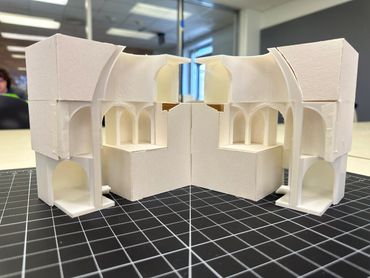
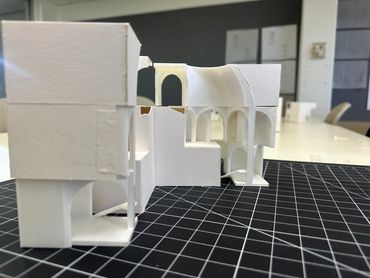
This project explored spatial organization and formal transformation through the subtraction of geometry from a solid cubic mass. Beginning with a set of randomly assigned simple three-dimensional shapes, the task was to iteratively push, pull, rotate, and combine these forms to carve a livable interior space without relying on conventional architectural elements such as doors or windows.
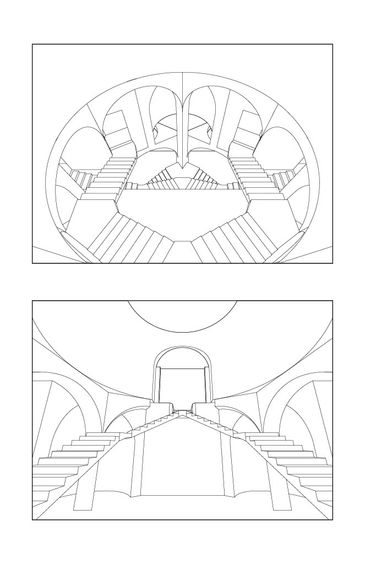
The final design is organized through bilateral symmetry, establishing a clear central axis that aligns visual connections across all levels. Three primary spaces—cleansing, dining, and dreaming—are stacked vertically and unified by this axis. Each level allows views through the center of the cube, reinforcing spatial continuity and orientation.
The cleansing space, located on the entry level, is compact and efficient, featuring a mirrored twin arrangement that establishes symmetry while minimizing spatial footprint. Above, the dining space becomes the dominant volume of the project, containing the greatest number of transformed shapes and acting as the primary social and spatial focus. The dreaming space mirrors the logic of the cleansing level, with two separated volumes connected by a central lookout, emphasizing balance and controlled separation.
As the project developed, the original geometries were adjusted to improve circulation, spatial clarity, and usability. In the final iteration, a custom dome was introduced at the upper level, allowing light to penetrate the interior while also acting as a vertical circulation and visual anchor. The resulting space prioritizes sectional relationships, symmetry, and geometric transformation as foundational architectural principles.